
Erie Projected and Actual Release
A projected date is a planning milestone derived from a sentence record. An actual release date records the event after it occurs. Between those points, parole review, legal holds, changes to custody credit, program requirements, and receiving-agency arrangements may intervene. Even a valid court or Board order may authorize release before staff complete the physical process.
Pretrial detention works differently. A person awaiting disposition at Erie County Prison has no sentence-based projected date. Bail, release on recognizance, dismissal, a new order, or transfer can end the county custody episode. Another docket or detainer can still prevent return to the community.
The wording matters. “Released from Erie County Prison” describes the end of county custody. “Paroled” describes conditional release under supervision. “Discharged” indicates a formal endpoint. “Transferred” means another custodian received the person.
Find Erie County Projected Release Dates
Begin with the sentencing source and facility operator. Erie County Prison is run by County Corrections. SCI Albion and other state institutions belong to PA DOC. A committing-county field in a state result does not turn a state sentence into a county sentence.
- Search the UJS Web Portal for the exact Erie docket. Read the sentence, jail-credit, concurrent or consecutive, and later order entries.
- For current state custody, use the PA DOC Inmate Locator. Match the inmate number and other identifiers.
- Check Parolee mode for a current state-parole result. Its useful date is labeled “Release Date,” not projected release date.
- Obtain the judicial minimum and maximum from the sentencing record, commitment papers, Board Action, or a DOC record request.
- For an Erie County Prison sentence, call County Corrections and Erie Adult Probation/Parole with the docket or booking number. Ask for the recorded authority and dates.
- Confirm an actual departure through the originating agency record or PA SAVIN event.
The Erie County release-record route shows how county, court, state, and notification evidence can be reconciled. No single live roster serves as a full historic discharge archive.
Erie DOC Release Date Fields
Pennsylvania's service has separate Inmate and Parolee modes and updates daily. The public interface does not display a projected or tentative release date, regular minimum sentence date, or maximum sentence date. The pertinent parole-side label is “Release Date.” Copy the label exactly rather than turning it into a prediction.
| Field or source | What it can establish | Limit |
|---|---|---|
| Inmate Locator | Current state institution, identifiers, committing county, photo | Current custody, not projected release |
| Parolee Locator release date | Date associated with current state-parole data | Not a full historic discharge archive |
| Sentencing order | Judicial minimum, maximum, and sentence structure | Not the door time |
| Board Action | Grant, refusal, deferral, and conditions | A grant may await prerequisites |
| Agency release record | Recorded actual event and destination | Request from the owning agency |
A person may move from the inmate side to the parolee side after state release. Someone who reaches the maximum may later disappear from both. Thus, no current match cannot prove when a past discharge occurred.
The manifest image for the official Pennsylvania parole process documents the minimum and maximum framework used for state parole questions.
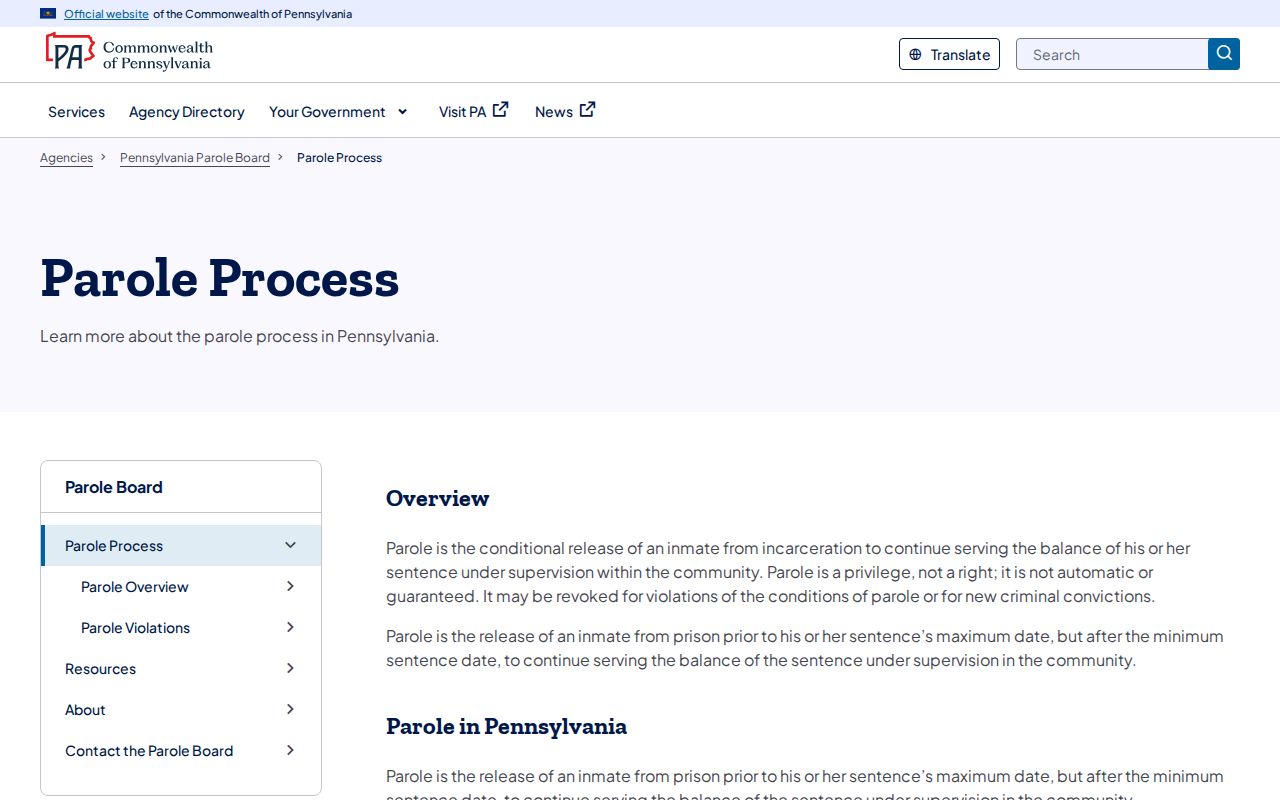
The source supports checking the sentence milestones and expressly rejects a universal 85-percent shortcut.
Erie Release Dates and RRRI
Under 42 Pa.C.S. § 9756, a sentence of total confinement generally states a minimum and maximum. The minimum ordinarily cannot exceed one-half of the maximum, subject to statutory exceptions. It sets the first ordinary parole-eligibility point. It does not command release.
Pennsylvania has no general rule requiring every state prisoner to serve about 85 percent before parole. Nor does the state apply a universal “good time” percentage. RRRI, the Recidivism Risk Reduction Incentive, is a distinct program for eligible sentences under 61 Pa.C.S. Chapter 45.
The difference between a minimum and a prediction is crucial. The minimum marks when ordinary parole can first become legally available. The Board may still deny or defer release. If it grants parole, the person may need an approved residence plan, a community corrections placement, completed programming, and resolution of all detainers before leaving the institution. The maximum marks the outside sentence endpoint based on the governing calculation, but another sentence or authority can still affect physical custody.
For an eligible sentence, section 4505 provides an RRRI minimum based on the imposed minimum, with different fractions above and below the statutory threshold and with rounding and aggregation rules. Eligibility, exclusions, sentence structure, program-plan compliance, and required certifications all matter. Section 4504 states that RRRI does not create a right to parole.
RRRI also cannot be read in isolation when sentences are aggregated. Consecutive terms may combine, and an ineligible component can affect the statutory calculation. The sentencing court determines eligibility in the first instance. DOC then evaluates the sentence and program plan, while the Board applies the release framework. That sequence is why a bare fraction cannot produce a safe Erie County projected release date.
Short Sentence Parole and reentry supervision are separate statutory routes with their own limits. Neither supports a home calculator that subtracts a fixed share from every Erie state sentence.
Why Erie Release Dates Change
DOC calculation begins with commitment documents, sentence structure, and lawful custody credit. Later records can change one or more inputs. Some events move the computed milestones. Others leave the dates intact but delay physical release.
| Factor | Effect on the release path |
|---|---|
| Custody credit correction | May change the calculated minimum or maximum. |
| Concurrent or consecutive terms | Changes the aggregate sentence across dockets. |
| New court order or sentence | Can alter the operative commitment information. |
| Detainer or unresolved charge | Can block community release or cause transfer. |
| Board grant, denial, or deferral | Affects parole timing after eligibility. |
| Home plan or bed availability | Can delay processing after a grant. |
| Programming, misconduct, or recommitment | Can change eligibility or the practical release path. |
A detainer is a request or legal hold from another authority. It can result in transfer when the Erie or state custody episode ends. In that situation, the person may be released from one institution without being free from all custody.
Home-plan review can also change timing without changing the judicial minimum. State parole staff investigate whether the proposed residence is acceptable. Some releases depend on a space in community corrections. If an approved plan expires, becomes unavailable, or conflicts with conditions, staff may need another plan before processing continues. The sentence milestone remains important, but it does not answer the practical question by itself.
Note: Multiple docket numbers should be read together because an order in one case may not end confinement under another case.
Erie County Sentence Computation
Do not apply a state-DOC calculator to an Erie County Prison sentence. Read the local sentencing order and confirm time credit under the governing record. Consecutive and concurrent terms must be treated as the court ordered them. Erie County Corrections and Adult Probation/Parole are the relevant local offices for the recorded county release or parole authority.
No official Erie source reviewed publishes a local automatic good-time calculator or a weekend-release rule. If a local sentence-computation or early-release policy is material, request the existing policy through Erie County's Right-to-Know process. Ask for the policy or record itself, not a new calculation made for the requester.
A focused local inquiry should supply the full name, docket or booking number, approximate admission date, and the sentence being checked. Ask for the recorded admission time, release authority, release date if one has been entered, and the destination or receiving agency where kept. Staff may limit oral disclosure, so a written request can preserve the answer. Court records and jail records should then be compared because a judicial order and physical departure are separate events.
This is the Erie-specific computation split. State sentences rely on PA DOC calculations and the Pennsylvania Parole Board process. County sentences rely on the Erie order, jail credit, and local custodial record. Federal sentences require federal sources.
Credit for time served can be especially important. It refers to lawful credit against a sentence for qualifying time already spent in custody. A dispute or correction under the sentencing record can alter the dates DOC or the county uses. The public docket may summarize the credit, but the actual order and commitment material control the agency calculation. Avoid estimating missing days from an arrest date alone.
Confirm Erie County Actual Release
PA SAVIN, accessed through VINELink, can provide a specific-person custody check and notifications for participating county jails, state prisons, and state parole. Registering for an alert is useful when the actual event has not occurred. Transfer and release are separate alert types, and delivery timing is not guaranteed.
The Erie County VINELink check describes the search and notification process. Save the status wording, facility, event time, and matching details. Then use the jail or DOC release record for formal proof.
For Erie County Prison, call 814-451-7500 with the booking or docket number. For state custody, use the current PA DOC contact route. A court order, minimum date, Board grant, release alert, and agency release timestamp answer distinct questions. Keep each fact tied to its source.
Record the time each dynamic system was checked. Daily state updates and custody-feed timing mean two accurate sources can briefly show different stages of the same event. Match the name with an inmate, parole, booking, or docket number before preserving a result. If a result disappears later, request the durable record instead of treating absence as a computed release date.
A federal sentence needs a different route. The BOP locator may show a past release date and “Released” status for a federal prisoner, but it does not calculate an Erie County Prison date. Likewise, an ICE custody result is about the federal immigration system. If a county record says the person was released to another authority, follow that receiving system and describe the Erie event as a transfer.
For a historic state discharge no longer visible in the live locator, request an existing PA DOC status or release record with the inmate number, institution, and date range. For a historic county release, ask Erie County for the corresponding booking and release entry. Durable agency records answer past-date questions more reliably than a current locator screen.