
Erie Courthouse Holding Role
The Sheriff courthouse holding facility is temporary staging. Its official history says the Sheriff assumed daily prisoner transport to the courthouse when the County Prison moved to Ash Street in January 1995. The site holds County Prison inmates brought for court and processes or holds new commitments until transport to the prison. It is not an independent county correctional institution.
That role changes the meaning of “released from the holding facility.” An inmate may simply return to Erie County Prison after a hearing. A new commitment may move from the courthouse to Ash Street. A court may authorize release, yet prison or Sheriff processing and a second hold can affect the actual outcome. The holding-site exit is not, by itself, proof that all custody ended.
| Courthouse movement | Likely meaning | Confirm with |
|---|---|---|
| Return after hearing | Continued County Prison custody | Erie County Prison |
| New commitment transport | Entry into prison custody | Commitment and prison record |
| Court-authorized release | Legal authority to release | Order plus physical release entry |
| Transfer to another authority | Local staging ended | Named receiving agency |
Confirm Erie Courthouse Release
Start with the court event because the person was at the courthouse for judicial business or commitment processing. Search the Pennsylvania UJS Web Portal at the right Erie court level. Use the docket number when known. Bail, disposition, sentencing, commitment, and later docket entries can explain the legal authority, though recent entries may not appear at once.
Next call Erie County Prison. Ask whether the matched person is currently held. If not, request the recorded release date, type, and receiving authority to the extent staff may disclose. PA SAVIN through VINELink can provide another custody-event signal. A Sheriff transport fact, a court order, and the prison release entry answer different questions and should not be substituted for one another.
- Identify the hearing or commitment and exact docket.
- Read the order and later entries for bail, sentence, remand, or transfer.
- Call County Prison with matching identifiers to verify the physical status.
- Check PA SAVIN for the participating custody feed's latest event.
- Follow a named receiving authority or request the existing record.
Important: A courthouse departure often means transport, not release into the community.
Erie Holding Facility Contact
The holding facility is located in the Erie County Courthouse. The official County page describes its function but does not publish a separate historical roster or release archive. Current prisoner status should be checked with Erie County Prison, while court documents come from the court record custodian. Use the Sheriff function page for the site's official role.
Erie County Sheriff Courthouse Holding Facility
Erie County Courthouse
140 West Sixth Street
Erie, PA 16501
Function: Temporary court holding and transport staging
Status checks: Erie County Prison, 814-451-7500
Court records: Erie Clerk of Records or Rule 509 records channel
The facility's temporary nature means the contact question should be narrow: Was the person returned to the prison, committed to the prison, released after the court event, or transferred? Staff access and disclosure may be limited. The formal records route depends on which office created the needed document.
Official Erie Holding Facility Source
The County's official holding-facility page explains the Sheriff's court transport and staging function.
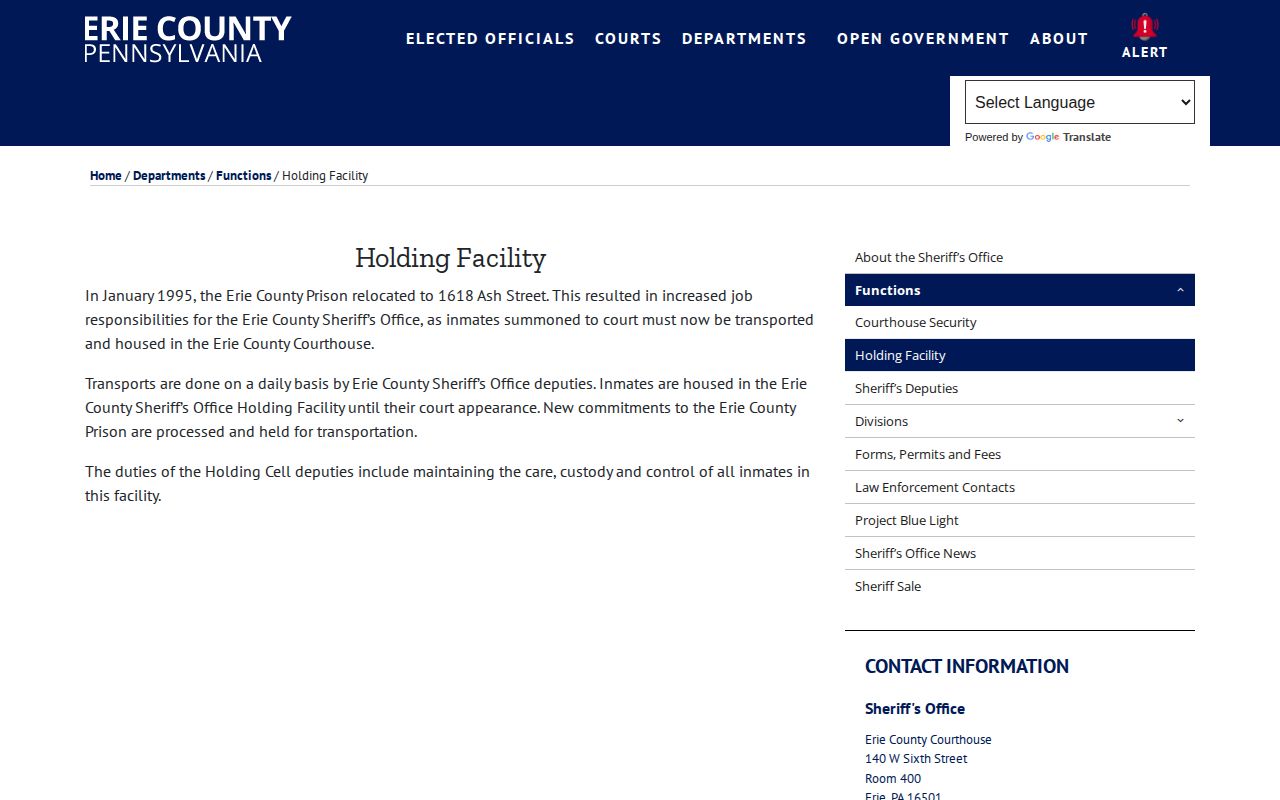
The official page confirms the operator and purpose. It does not supply a person-level release result, so use it to route the inquiry, then pair it with the court and County Prison record.
Erie Courthouse Custody Records
Several records may document one courthouse movement. A transport or holding record can show the Sheriff's physical handling. The docket or order can show why the person appeared and what the judge authorized. A commitment document can support transport to jail. The County Prison admission or release entry can show whether Ash Street custody began, continued, or ended.
Ask for existing records, not a new narrative. Identify the person, docket, hearing date, and approximate transport time. Request the relevant transport, holding, commitment, or release field that the chosen office maintains. If seeking the prison release entry, use the County Right-to-Know channel and direct the request to the designated open-records officer. Judicial records follow court rules rather than the local agency request route.
A County request should be bounded by name, identifier, and date. Ask for electronic production and request that any protected portion be redacted while the rest is supplied. The Pennsylvania Right-to-Know process generally calls for a grant, a denial that states legal grounds, or an extension notice within five business days. An extension may add up to thirty calendar days unless the requester agrees to more time.
Permitted charges can include duplication, certification, postage, or specialized production. Ask for a cost estimate over a chosen limit. If the response denies an agency record, the ordinary Office of Open Records appeal period is generally fifteen business days from the denial or deemed denial. Court records use their own judicial channel, so do not apply the agency appeal route to a Clerk document without checking the governing court rule.
| Record | What it may establish | Likely custodian |
|---|---|---|
| Docket or order | Court action and legal authority | Erie courts |
| Transport or holding record | Physical staging movement | Sheriff |
| Commitment | Direction to confine or transport | Court or receiving agency |
| Prison release entry | End time, type, and destination | County Corrections |
Note: Request each document from the office that created or keeps it because one Erie office cannot supply every part of the timeline.
Erie Court Orders and Release
A court order can authorize bail, release, remand, or a sentence outcome. “Remand” means sending the person back into custody under the court's direction. The order should be read with every active docket. Release in one case may not overcome a commitment, consecutive sentence, or detainer in another matter.
The docket is strong legal context but does not certify the minute the holding cell or prison door opened. Processing, identity checks, and other holds can intervene. For a reliable sequence, keep the signed or docketed order with the Sheriff's movement record and the County Prison entry. If the portal summary is unclear, request the underlying document from the Erie Clerk of Records.
Erie County Custody Distinction
Being physically at the Erie courthouse does not identify the long-term custodian. A person may belong to Erie County Prison, arrive as a new commitment, or be handled for another authority. Erie County also contains SCI Albion, a PA DOC institution. A state prisoner brought into a county court context remains part of the state system unless a supported record says otherwise.
Always note the operator and destination. County Prison releases belong to County Corrections. SCI Albion releases belong to PA DOC. Sheriff holding events belong to the temporary courthouse function. This is the local meaning of the distinction between “in Erie County” and “held by Erie County.” The Erie County Prison release route supplies the separate Ash Street record process.
After Erie Courthouse Departure
After court, the person may return to the County Prison, enter the prison as a new commitment, transfer to another custodian, or complete release processing. Confirm the actual destination before using the word release without a qualifier. A van leaving the courthouse says nothing by itself about the final legal status.
If County Prison receives the person, follow County Corrections and PA SAVIN. If PA DOC receives the person, use the state inmate locator. If the court released the person under county parole or probation, use the sentencing docket and Erie Adult Probation/Parole. If another agency took custody, that agency becomes the next source. Save the date, time, and exact source wording.
County parole means supervised release from a county sentence. Probation is court-ordered community supervision and may follow confinement or occur without it. Neither should be confused with Pennsylvania Parole Board jurisdiction over a state sentence. The Erie docket identifies the sentence source and helps route the follow-up office.
Note: The courthouse holding site has no separate official recent-release feed, so an absent web result cannot confirm a departure.