
Erie County Parole or Probation
Parole and probation both involve rules in the community, but they begin in different ways. Probation is a sentence imposed by a court. It may be ordered without a prison term or after a period of confinement. Parole is conditional release before the maximum end of a custodial sentence. A person on parole is still serving that sentence outside the institution.
Jurisdiction is just as important as the label. Erie County Adult Probation/Parole generally handles county probation and parole from a county sentence. PA DOC field services supervises state parolees, while the Pennsylvania Parole Board decides state parole grants and recommitments. The Board is not Erie County's probation office.
| Feature | County probation or parole | State parole |
|---|---|---|
| Source | Erie court order or county sentence | State sentence and Parole Board action |
| Primary office | Erie County Adult Probation/Parole | PA DOC parole field services |
| Public starting point | UJS sentencing docket | PA DOC Parolee Locator |
| End point | Court or county supervision discharge | Maximum sentence or formal state discharge |
- Parole
- Conditional release while a custodial sentence is still running.
- Probation
- Court-ordered community supervision that may be imposed with or without confinement.
- Discharge
- The formal end of custody or supervision, not merely release from a building.
- Absconder
- A supervised person alleged to have stopped reporting or whose location is unknown.
Verify Erie County Post-Release Supervision
Start with the case, not an assumption based on where the person lives. A person living in Erie may be on state parole from an institution elsewhere. Someone released from Erie County Prison on a county sentence may instead report to the local office. Exact docket and inmate or parole numbers reduce same-name errors.
- Search the Pennsylvania UJS Web Portal. Select the proper court level and Erie County, then read the sentence and later supervision entries.
- If the sentence is state custody, use the PA DOC locator and select Parolee mode. Match more than a name.
- Record the release date, current location, last update, identifiers, and any explicit wanted-parole-absconder flag shown in the state result.
- For a county case, contact Erie County Adult Probation/Parole and ask which public record confirms active or inactive status. Disclosure may be limited.
- Confirm any important current question with the office listed in the result. Locator data updates daily rather than in real time.
A PA SAVIN event can add custody-change context, but it does not replace the sentence record or supervision office. The broader Erie County released inmate search explains how jail, court, SAVIN, and DOC records fit together.
Note: No state locator match means only that no current match appeared; it does not prove a past sentence or supervision never existed.
Erie County Supervision Offices
Erie has two main supervision routes. The local office handles county court programs, including probation, county parole, ARD, electronic monitoring, and pretrial matters. State parole questions belong with the PA DOC field office directory. A physical location at a community corrections center can still be part of custody or supervised placement, so it should not be called final discharge without a supporting record.
Erie County Adult Probation/Parole
140 West Sixth Street, Room 306
Erie, PA 16501
814-451-6216
Monday through Friday, 8:00 a.m. to 4:30 p.m.
After-hours emergency line: 814-451-1503
For state parole, consult the PA DOC parole office directory. Official materials list the Erie District Office telephone as 814-871-4201, but the live directory should supply the current address and hours. The Pennsylvania Parole Board makes release decisions; field staff supervise after release.
The distinction is concrete in Erie County. SCI Albion is a state prison in the county, while Erie County Prison is a county facility. A parolee from SCI Albion remains in the PA DOC system even if the person reports in Erie. County supervision instead follows an Erie court order or county parole authority.
Erie Release Violations and Absconders
Supervision conditions come from the governing order and office. They may address reporting, approved residence, travel, treatment, contact, or other case-specific duties. Public summary pages cannot establish the full terms for one person. The signed order, Board Action, and supervising office are the better sources.
The state Parolee Locator may show an explicit “Wanted: Parole Absconder” flag. Report that exact label and the update date. It is evidence of state parole status, not proof of a new conviction. Erie County has no verified public countywide probation absconder database. Individual warrant posts can be incomplete or stale, so current warrant status must be checked with the issuing court or agency.
Violation hearings answer a different question from initial parole. Official preliminary-hearing information addresses detention on a Board warrant, while the revocation process concerns proceedings after a new conviction. Outcomes may include continued parole, detention pending a later hearing, or recommitment. They should not be mixed with an initial grant or denial.
Erie State Parole Decisions
The Pennsylvania Parole Board does not provide a public, person-by-person calendar of upcoming interviews or a searchable database of each grant and denial. Its Board Decision page describes the process, and monthly reports give aggregate data. Those sources cannot establish one person's outcome.
For an individual result, use the written Board Action held by the person, institution, or attorney, or submit a focused records request subject to exemptions. A grant may still depend on the minimum date, an approved home plan or community corrections bed, program steps, and detainer resolution. A Board grant is authorization subject to conditions. It is not the timestamp when the institution opened the door.
The official parole process also explains that parole is not guaranteed. The minimum sentence date creates eligibility for ordinary consideration, while the maximum is the sentence endpoint unless another lawful event changes custody.
The parole process can be checked against the official locator service, but the two sources have different roles. Process material explains how a decision is made. A person-level locator result reports current state supervision data after the release event has entered the system. Neither source replaces the written Board Action when the exact decision language matters.
The manifest image from Pennsylvania's official inmate and parolee locator service shows the state search route available for an Erie County supervision check.
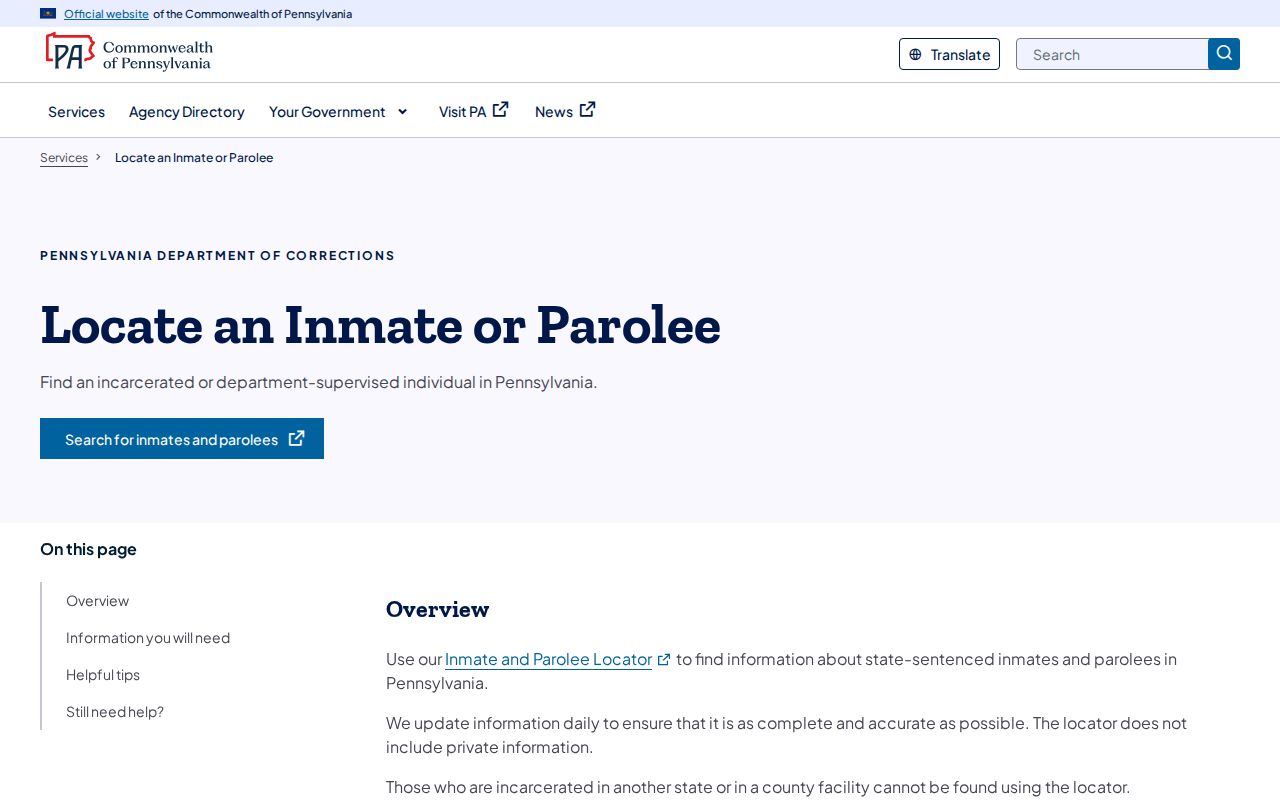
The source confirms that current inmate and parolee searches are separate and should be matched to the correct sentence system.
Note: Pennsylvania Board of Pardons dates concern clemency, not ordinary Parole Board interview dates or state parole release decisions.
Erie Release Reentry Routes
Erie's local reentry landscape includes county programs, PA DOC community corrections, and state parole field supervision. These labels are not interchangeable. The County Community Resource Center is a day-report and court-supervision program. Erie Community Corrections Center and CTC Erie operate within the state community corrections system. Placement at any of them can involve continued rules and oversight.
Use the sentencing docket to identify the source of authority. Then check the office that owns the supervision. County cases go to Erie Adult Probation/Parole. State parolees go through PA DOC. A street address or permission to work in the community does not prove the sentence ended.
PA SAVIN can notify registered users of participating release, transfer, movement, or escape events. Those event types must stay separate. A transfer from an SCI to community corrections may be an important change, but it is not necessarily discharge from the state sentence.
Erie Release Property and Corrections
Erie County Corrections directs inmate property questions to its main information line. After a county release, call Erie County Prison at 814-451-7500 to ask about current pickup authorization, location, identification needs, and retention instructions. No sourced public deadline should be assumed.
An error in a release or supervision entry should first be raised with the agency that created it. Provide the booking, inmate, parole, or docket number and identify the exact field believed to be wrong. Keep the correction request and response. A court docket issue belongs with the court record custodian, a county prison entry with County Corrections, and a state locator entry with PA DOC.
This routing prevents one agency from being asked to fix another system's data. It also preserves the difference between a jail departure, a parole release, a transfer, and final discharge.
Erie County Supervision Discharge
Supervision ends through the authority that imposed or administers it. A county probation or parole term may end under the Erie court record and county office. State parole generally runs within the state sentence framework until maximum expiration or another formal discharge event. Leaving a facility does not by itself end either form of oversight.
For county supervision, obtain the relevant docket order or written office confirmation. For state parole, preserve the locator result and request the formal status or discharge record when live data no longer answers the question. Pennsylvania's Right-to-Know Law can provide access to existing agency records, subject to exemptions, redaction, and other laws. It does not require an office to create a new explanation.
PA SAVIN and locator results are useful time-bound evidence. Formal proof should come from the originating court or corrections agency. Record the date checked and match multiple identifiers before linking any status to a named person.